Literature Search
Search for publications on antisemitism and healthcare professions in PubMed yielded 23 articles (
Figure 1) and in ProQuest, 46 items (
Figure 2). Additional records identified through hand search tracking yielded an additional 49 articles.
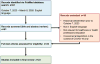 | Figure 1 PRISMA Diagram for PubMed Search Shows the Process of Review, Inclusions, and Exclusions. |
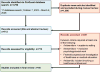 | Figure 2 PRISMA Diagram for ProQuest Search Shows the Process of Review, Inclusions, and Exclusions. |
Quantitative Evidence on Antisemitism in the Health Professions Since October 7, 2023
Quantitative evidence on antisemitism in health professions education and practice in the US, UK, Canada, and Australia is summarized in
Table 4. The evidence included peer-reviewed surveys, surveys reported in media sources, an observational analysis of medical-school commencement ceremonies, and a quantitative social-media analysis.
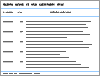 | Table 4 Quantitative Evidence on Antisemitism in Health Professions Education and Practice. |
The initial PubMed search for antisemitism in the healthcare professions yielded 61 records. For context, parallel searches with the same search strings but instead using the terms diversity, equity, and inclusion (DEI), and racism yielded 732 and 3,824 records, respectively—12 and 63 times the number retrieved by the antisemitism search during the same period.
Reported Examples of Antisemitism in the Health Professions Since October 7, 2023
This section summarizes incidents and experiences described in peer-reviewed publications, media reports, governmental documents, and organizational sources; the nature and evidentiary status of these sources vary.
Medicine. In the US, medical school faculty and health practitioners posted antisemitic tropes and derogatory comments about Jews in healthcare; medical students’ social media claimed Jews wielded disproportionate power (an antisemitic trope).30 Class content at the University of California–Los Angeles (UCLA) David Geffen School of Medicine (DGSM) labeled Jewish people as oppressors (demonization),31,32 and anti-Jewish hate graffiti appeared at University of California–San Francisco (UCSF).6 Jewish patients at UCSF hospitals feared revealing their identities, hospital staff shouted “intifada,” and social media of trainees and faculty rationalized terrorism against Jews.6,33–35 A UCSF physician was quoted as saying “When that chant goes up and is heard in the patients’ rooms, …. it’s a violation of our professional obligations as health care providers.”34
Protesters outside academic medical centers in New York City shouted “we don’t want no Zionists here” and carried signs including “Abolish Israel,” “Right of Return,” and “There is only one solution—intifada, revolution.”36 Jewish students and practitioners in health professions described isolation and fear of retribution for speaking out and for their safety.2 Jewish trainees scrubbed resumes and hid their religious beliefs.37,38 A leader of a Jewish organization at Brown University commented, in reference to a demonstration during a medical school commencement ceremony (which included chants heard from outside of “From the River to the Sea,” a slogan delegitimizing and calling for the elimination of the State of Israel), that “Jewish students are unfairly expected to bear the burden of unchecked micro and macro aggressions directed at them by peers.”39
At UCLA DGSM, Jewish students experienced “hostility and fear … from peers, colleagues, and administrators,” and “their concerns were not addressed by the university.”6 A UCSF Professor of Medicine was dismissed, but only after nearly two years of repeated anti-Zionist libels, unfounded accusations, and targeting of an alleged Israeli-born medical student.6 An Icahn Mount Sinai School of Medicine faculty member was terminated for supporting terrorism and anti-Israel libel.40
In addition to physicians’ social media vilifying Israel, some physicians at the Faculty of Medicine, University of British Columbia (UBC, Canada) “asserted that Jewish faculty should not be allowed to adjudicate resident matching because the examining doctors were Jewish and might be racist,” and in November, 2023, “1/3 of all UBC medical students signed a petition endorsing this call. Jewish learners who refused to sign were harassed by staff and students.”25 Despite almost 300 Jewish physicians signing a letter expressing concern about tolerance of Jew hatred and hostile academic environment, antisemitism was not recognized by leadership.25 A valedictory speech for the 2024 class of the Max Rady College of Medicine, University of Manitoba included demonization of Israel, and the student who delivered it received a standing ovation from fellow graduating students.41
A UK tribunal suspended a physician for 15 months “after ruling her antisemitic and extremist social media posts fell far below professional standards and posed a high risk of re-offending.”42,43 But a medical journal termed these posts “allegations” of antisemitic remarks.43 The physician’s social media activity included three reported examples: (1) describing the temporary restriction of emergency department access in Manchester, which was intended to prioritize victims of a local synagogue attack, as evidence of “exceptionalism for Jews;” (2) sharing a social media post that characterized media coverage of the attack as “Jewish supremacism;” and (3) calling on Jews to denounce Israel or renounce Israeli citizenship. This physician was subsequently arrested after violating bail conditions and was charged with inviting support for Hamas.44
In a separate case in Belgium, a radiologist reportedly identified a patient as Jewish in the patient’s medical documentation, raising concerns about privacy and professional conduct. The physician was later suspended after antisemitic cartoons posted on his social-media account in 2023 came to light.45
Dentistry. Reports have described antisemitism in dental workplaces, academic institutions, and international dental organizations, including harassment and hostility directed at individuals because of their Jewish identity or support for Israel.46 “Some Jewish professionals are now hesitant to wear faith symbols or identity in their own workplaces, fearing retaliation, ostracism, or subtle professional retribution” and “quiet but persistent normalization of exclusion which occurs often under the radar but is just as damaging.”46 Dentists in Miami and Boston tore down posters of Israelis kidnapped by Hamas terrorists and were ultimately fired.47,48 A US congressman called for revoking the license of a Florida dentist who made antisemitic statements when preaching in his role as an imam after the October 7, 2023 terrorist attack by Hamas against Israel.49
Nursing. An Australian nurse and lifestyle influencer posted a video in which she appeared to perform a Nazi salute, then issued an apology.50 Australian nurses threatened Israeli patients during an online chat. One boasted she would refuse to treat Israeli patients and threatened to kill them. Another claimed he had sent Israeli patients to “Jahannam” (Arabic for hell).51 Both were dismissed from their positions and criminally charged, with their cases scheduled for trial in August 2026. An Oregon Health & Science University nurse was terminated for referring to advocates for Israel as “vermin,” writing she would “… not treat them.”52
Psychology. An open letter to the APA from Psychologists Against Antisemitism and others (4,000 signatories) documented the following: (1) “insensitivity toward Jews, a lack of concern regarding antisemitism, minimization of aggression towards the Jewish people, and outright hostility and prejudice toward Jews and Jewish heritage,” including “listservs containing antisemitic discourse, often masked as anti-Zionism;”53 and (2) the APA offering educational credits for members to attend conferences where speakers endorsed violence against Jews and Israelis, invoked antisemitic tropes, distorted the Holocaust, minimized Jewish experiences, and pathologized the Jewish people’s connection to their indigenous homeland.53
An article in the APA’s flagship journal American Psychologist showed “clear animus to Jewish people and Israel,” repeatedly labeled Israel a “settler-colonial” and “apartheid” state, distorted history, and advocated for “decolonial psychology practice,” which “politicizes the field of scientific psychology and falls drastically short of scholarly standards.”54 A psychologist who directs Villanova University’s Counseling Center associated Zionism with fascism and colonialism during a professional psychology conference in Philadelphia.55
The Brandeis Center and Physicians Against Antisemitism criticized Decolonizing Therapy for identifying Zionism as a root cause of mental illness.56 Marcus (of the Brandeis Center) argued that this practice equates Zionism—described as “an integral component of Jewish identity for many Jewish Americans” and as the belief that Jews have a right to self-determination in Israel, their ancestral homeland—with colonialism and oppression.57 Marcus elaborated that this “xenophobic hatred under the guise of therapy” delegitimizes Jewish historical, cultural, and ethnic connections to Israel and denies the Jewish people’s more than 3,000-year history with the land.57 Decolonial and liberation therapies incorporate antisemitic narratives including anti-Zionism and identity-based discrimination into cognitive behavioral therapy (CBT).58 Allowing such narratives “to shape theory and practice undermines the profession scientifically, ethically, and clinically.”58
The lack of meaningful response to these developments prompted a US congressional investigation,59 which one commentary described as evidence that the “APA’s antisemitism reckoning has finally arrived.”60 The state of Illinois formally reprimanded a therapist who had created a list of “Zionist” therapists and encouraged colleagues not to refer clients to those therapists.61
Social work. Responses to antisemitism within the social work profession have lacked action steps, such as encouraging social workers “to reflect on their own internalized anti-Semitic biases.”62 A survey of US social workers’ experiences with antisemitism in both education and the workplace revealed antisemitic comments from peers, office workers, and staff and identified the following themes: (1) being considered “white and privileged” to minimize and dismiss Jewish experiences, (2) “micro-aggressions” against Jews seldom addressed and often dismissed, and (3) merging antisemitism with anti-Zionism and the demonization of Israel, most prevalent in graduate schools.63 These researchers noted that antisemitism was seldom included in social work education or diversity and inclusion programs, inconsistent with its approach to social justice and maintaining a truly inclusive profession.63 Other researchers likewise noted its omission from institutional responses since October 7, 2023.64 This omission is inconsistent with the profession’s commitment to social justice and to maintaining a truly inclusive profession.62 They thus recommend including the topic of antisemitism in social work curricula and diversity and inclusion programs in accordance with the profession’s ethics and competencies through the Council on Social Work Education, the accrediting agency for social work education in the US and its territories. In 2024, an Ontario-based Jewish social worker was publicly labeled “racist’” and “anti-Arab” for challenging her colleague’s assertion that Zionism is a “genocidal ideology.”65
The Jewish Social Work Consortium report described the targeting of Jewish social workers on national listservs and antisemitic rhetoric in academic settings, with Jewish students studying social work termed “racist” and “white supremacists.”66 The report also raised serious concerns about the National Association of Social Workers, the largest membership organization of professional social workers (110,000 members), including its two-month delay in publicly addressing the massacre of October 7, 2023 and its allegedly inadequate response to antisemitism and inadequate efforts to counter it in the aftermath. Columbia University reached a settlement in a former School of Social Work student’s Title VI lawsuit alleging antisemitic discrimination.67
Occupational therapy. It has been deemed essential within the occupational therapy field for faculty to develop and implement programs for practitioners, students, and other professionals and create a culture of belonging in light of the sharp rise in antisemitism “to prevent occupational injustice among Jewish students.”68
In summary, the themes or patterns across these specific examples of antisemitism in the health professions are similar, if not identical. They encompass manifestations of antisemitism as outlined in the IHRA guidelines, ranging from outright threats of bodily harm against Jews to the use of antisemitic tropes and libels to demonize and delegitimize Israel and apply double standards to it—Israel being the ancestral homeland of the Jewish people and an integral component of the identity of most Jews.
Actionable Recommendations for Countering Antisemitism in the Health Professions
Countering antisemitism in medicine is a “moral imperative,”
2 where the “4Es” serve as an action framework,
2 i.e. Education, Engagement, Empathy, and Enforcement. These 4Es were recently endorsed by the Antisemitism Policy Trust of the UK in their Antisemitism in the Healthcare Sector Since October 7, 2023 report.
69 A recent study found that people holding antisemitic attitudes and tropes were less educated on Jewish history,
70 highlighting the importance of education in reducing antisemitic beliefs.
15 Education in this framework includes history of medicine’s complicity in the Holocaust,
2,
71 with an important caveat on any Education component in this domain: “Honoring the memory of the Holocaust is a sacred obligation. Yet it cannot be done effectively or have any real meaning in a context divorced from the current struggle for Jewish survival against a rising tide of bigotry, hatred, and violence.”
72 In other words, “Don’t mourn the Holocaust while supporting the genocide of living Jews.”
72 Some reported patterns—particularly the dehumanization, exclusion, and professional targeting of Jewish healthcare workers—echo patterns documented in pre-Holocaust Nazi Germany. One contemporary example of such echoes in medicine is the Committee of Interns and Residents, the largest union of resident and fellow physicians in the US, representing more than 37,000 physicians, which has supported figures associated with anti-Israel terrorist organizations, recommended the exclusion of Israeli employees from hospitals, adopted resolutions with libelous claims of “apartheid” and “genocide” against Israel, supported the Boycott, Divestment, and Sanctions (BDS) movement, and required dues from federally funded trainees—actions that help perpetuate antisemitic bias in medicine.
73,
34 The Committee of Interns and Residents is currently the subject of a US Congressional investigation.
73,
34 This history underscores the need to recognize and address the broader implications of the dehumanization, exclusion, and persecution of Jewish health professionals, as well as the extent to which antisemitic hatred can escalate.
2,
71 It also demonstrates how antisemitic incitement can lead—and historically has led—to deadly violence. Actionable recommendations and actions taken based upon the narrative review are presented in
Table 5.
| Table 5 Actionable Recommendations and Examples of Actions Taken. |